

Seeing a product on social media rarely leads to an instant purchase. What it does trigger, however, is action.
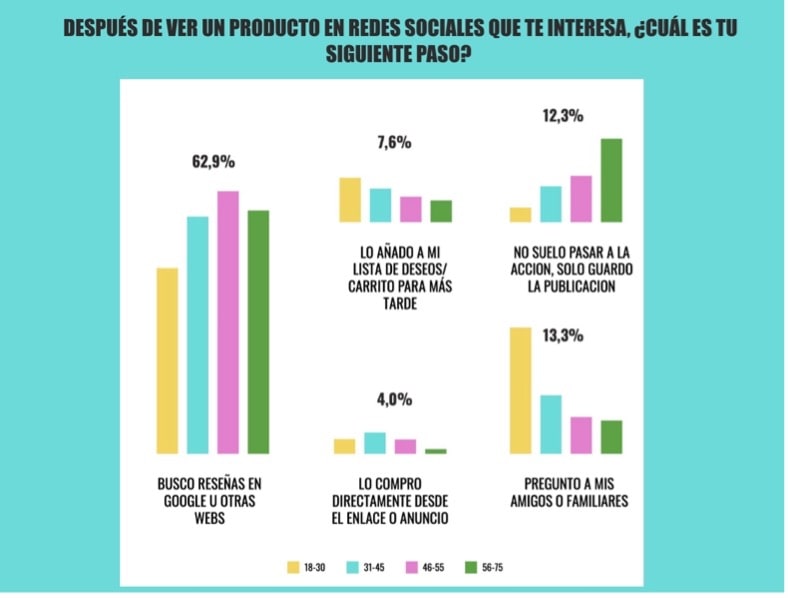
According to new research by communications agency APPLE TREE, 62.2% of users who see a product on social media go on to actively search for it, usually on Google or other platforms, as part of their purchase evaluation process.
This is one of the key findings of Brands under the Tyranny of the Algorithm, a study by APPLE TREE analysing current trends in digital communication. The research is based on a survey of more than 1,000 social media users in Spain aged between 18 and 65.
The study was presented in Barcelona, alongside a roundtable discussion with Ana Gutiérrez, Corporate Deputy Director of Digital Channels at MAPFRE, and Ricard Cardona, Trade and Media Lead at Reckitt Nutrition, who explored the implications of the findings for brands and marketers

From inspiration to validation
The research shows that users most often look for external validation before moving towards a purchase. Reviews on Google, third-party websites and opinion platforms play a crucial role in confirming or questioning what social media has suggested.
This behaviour reflects a more critical mindset. Social platforms spark interest, but trust is built elsewhere before the decision is made.
For Julio Fernández-Sanguino, Partner and Director of the agency’s Digital area and head of the study: “From the very beginning, social media has been asked to prove its ability to convert directly into sales. Over time, we’ve realised that, at least in the Western world, direct conversion is not its primary role. Social media is where inspiration begins, where desire is created and brand and product awareness are built.”
The decision journey starts with the scroll
Social media is thus establishing itself as the main channel for inspiration before making a purchase. When it comes to direct purchasing, although platforms such as TikTok and Instagram (10.8%) are beginning to use these as points of purchase for products without leaving the app, the truth is that the vast majority turn to videos, reels, or visual recommendations as a first step before making a purchase. This trend confirms that the decision-making process no longer begins on Google, but rather with scrolling.
The APPLE TREE digital team also analysed how social platforms have evolved in recent years. What began as spaces for personal connection have become mass media channels, driven by influential users competing for algorithmic visibility. In this constant battle for relevance, brands face increasing difficulty in ensuring their content is seen.
For Julio Fernandez-Sanguino, partner and digital director at APPLE TREE: “This change in habits poses a clear challenge for brands and creators: content needs to be easily discoverable within social platforms themselves, not just through external search engines. At the same time, credibility and usefulness are essential. In environments where anyone can appear as a result, clarity and real informational value are what make the difference.”
Managers and companies regain confidence in social media
In a content-saturated landscape, trust has become a decisive factor. According to the study, friends, acquaintances and people from users’ immediate circles remain the most trusted sources, with a trust index of 5.6. They are followed by media outlets and journalists (5.3), particularly among users aged over 46.
Notably, trust in business leaders has grown by 20.3% among the general population, opening up new opportunities for executives who are building personal brands rooted in leadership and expertise.
When it comes to content creators, overall trust has declined slightly compared to last year. Even so, authenticity remains the most valued quality, cited by 29.3% of users. The message is consistent: audiences want voices that feel genuine, informed and human, not overly polished or performative.
Download the full report here


